


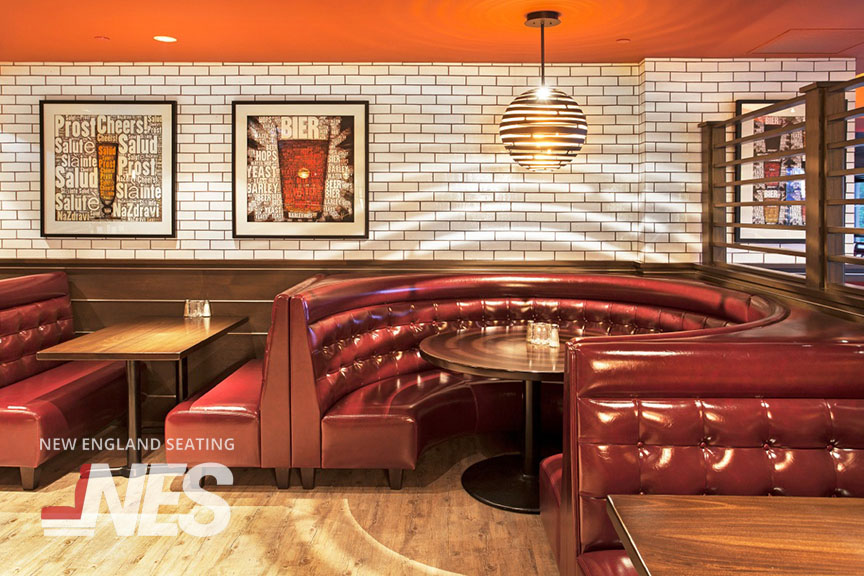
Tufting vs. Channels: Choosing a Back Style for Your Brand
When you step into a restaurant, your brain processes the “vibe” in less than three seconds. You haven’t tasted the food or seen the wine list yet, but you’ve already decided if this is a place for a quick burger or a three-hour anniversary dinner.
As a manufacturer here in New Haven, I can tell you that a huge part of that “three-second math” comes down to the stitching on your seating. The back style of a booth is the largest visual surface in your dining room. It’s the “wall” of your floor plan.
Choosing between Tufting and Channels isn’t just an aesthetic choice; it’s a branding strategy.
The Vertical Channel: The Modern Workhorse
If your concept is a high-energy modern diner, a sleek corporate cafeteria, or a mid-century cocktail bar, the Vertical Channel is your best friend.
By creating clean, repetitive vertical lines, this style draws the eye upward. In a space with lower ceilings—common in many of our historic New England buildings—this trick of the eye makes the room feel airy and expansive.
- The Vibe: Organized, efficient, and “retro-cool.”
- The Practical Side: Channels are incredibly easy to clean. There are no deep “nooks” for crumbs to hide in, making this a favorite for high-volume breakfast spots and family-friendly joints where the turnover is fast and the cleaning crew needs to move quickly.
The Diamond Tuft: The Signature of Luxury
On the opposite end of the spectrum is the Diamond Tuft. This is the “Old World” standard. We’ve been hand-pulling these tufts in our shop for decades, and there is simply no shortcut to doing it right.
Each button and fold creates a pocket of shadow and highlight, giving the material a three-dimensional, “plush” look that screams high-end.
- The Vibe: Intimate, expensive, and classic. It’s the “Steakhouse Standard.”
- The Practical Side: Tufting provides a slightly different “sit.” Because the material is pulled tight at specific points, it creates a firmer, more supportive back that encourages guests to settle in. It tells your customer that this is a place where they are expected to linger over an appetizer and a second round of drinks.
Horizontal Channels and Plain Backs: The Minimalists
Of course, the catalog doesn’t stop there.
- Horizontal Channels: These create a sense of width, making a narrow “railcar” style dining room feel much wider and more lounge-like.
- Plain Backs: Sometimes, the material is the star. If you’ve invested in a stunning COM (Customer’s Own Material) with a bold pattern or a heavy grain, a plain back allows that fabric to speak for itself without the interruption of stitching.
Which One Fits Your Menu?
Before you flip through the catalog, ask yourself: What is the average check I’m chasing? If you want high-volume “turn and burn,” go with the clean lines of a Vertical Channel. If you want the “Linger Effect” of a fine-dining institution, invest in the craftsmanship of a Diamond Tuft.
In New Haven, we build both with the same 10-year structural guarantee. The style is up to you; the durability is on us.