


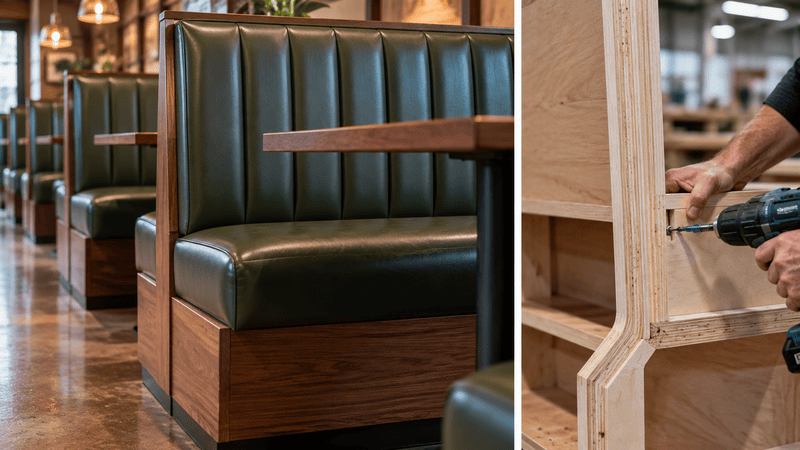
The “No-Wobble” Guarantee: Engineering the Perfect Commercial Frame
In this shop, we have a saying: “A booth is only as good as the skeleton underneath the vinyl.”
If you’ve ever sat in a restaurant booth and felt the back give way just a fraction of an inch when you leaned into it, you’ve experienced “back wobble.” To a customer, it feels cheap. To a restaurant owner, it’s the sound of a ticking time bomb. That tiny movement is the friction that eventually pulls staples out of wood, snaps joints, and leads to a costly replacement long before your lease is up.
At New England Seating, we’ve spent generations in New Haven perfecting a frame that simply doesn’t move. Here is why the “hidden” engineering of your seating is the most important part of your floor plan.
The Particle Board Problem
If you look at the budget options flooding the market today, most are built using particle board or medium-density fiberboard (MDF). These materials are essentially sawdust and glue pressed into a sheet. They are heavy, they are brittle, and most importantly, they have zero “screw-holding” power.
Once a screw or staple starts to pull out of particle board, there is no fixing it. The hole just turns back into sawdust. In a high-volume environment where dozens of different people sit, lean, and shift in that booth every single day, particle board is a recipe for a three-year replacement cycle.
Our Solution: High-Grade Shop Plywood
We do things differently. Every custom booth that leaves our facility is constructed from high-grade shop plywood. Unlike particle board, plywood is made of layered wood veneers glued in alternating directions. This gives the frame incredible structural memory and strength. When we drive a fastener into our plywood, the wood fibers “grip” it. It stays put for decades, not months.
The Secret: One-Piece Construction
Materials are only half the battle; the “how” matters just as much as the “what.” Most manufacturers build the seat and the back as two separate pieces and then join them together. That joint is a natural point of failure.
We utilize a one-piece construction method. By overlapping the structural plywood components, we create a unified “truss” system. It’s the same principle used in bridge building. By distributing the weight and pressure across the entire frame rather than a single joint, we eliminate back wobble entirely.
The Question Every Owner Should Ask
When you are shopping for quotes, I want you to look a salesperson in the eye and ask one simple question: “Is the internal frame made of particle board or plywood?”
If they hesitate, or if they tell you “it doesn’t matter because it’s covered in fabric,” walk away. They are selling you a disposable product. We don’t build disposable furniture in New Haven. We build commercial seating meant to be a permanent part of your legacy.